← back to the build document · the rack for the lengthwise layout · building the roof rack · the design history · mounting the a/c & fan · the roof frame · the parts list · the build manual
Standard brackets for our DIY rack
Same rack as before — gutter side rails, raised supports, crossbars above the roof crown. What changes is how the corners get made. Instead of cutting baseplates, drilling angles and making gusset cheeks, the joints become ordinary catalog strut fittings you order by part number.
Below: the main fitting, the secondary one, the rail and nuts they mate with, and a T-slot alternative if the upper frame goes that way instead. Cutting a stock rail or upright to a measured length is still on the table — that is buying material to size, not fabricating a bracket, and the two are kept separate here.
Catalog parts and connections
product identification and conceptual assembly · not an approved load or vehicle connection, and not a locked rack design
Three sheets, in order: the parts themselves as supplier photographs with the IDs used everywhere else on this page, one corner drawn assembled and exploded with the bolt actually shown in contact with its nut, and the upper frame in context over a crowned roof. Two catalog families appear, and they stay separate: aluminium 15-series T-slot (G1/G2 gussets, U1/L1/X1 profiles) and steel strut fittings with an aluminium channel option (S1/S2/S3). Members can be cut to a measured length; nothing here is a fabricated bracket.
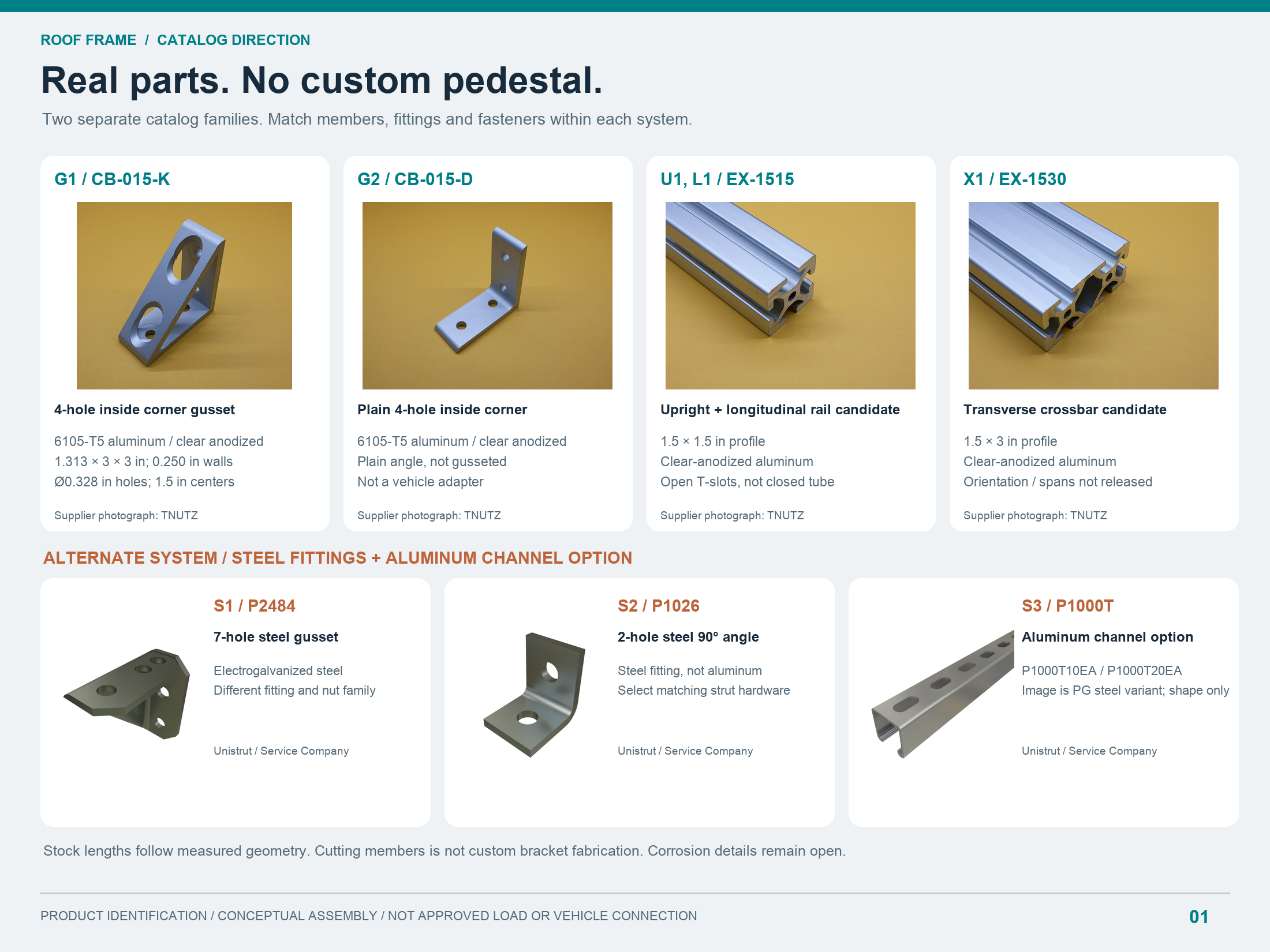
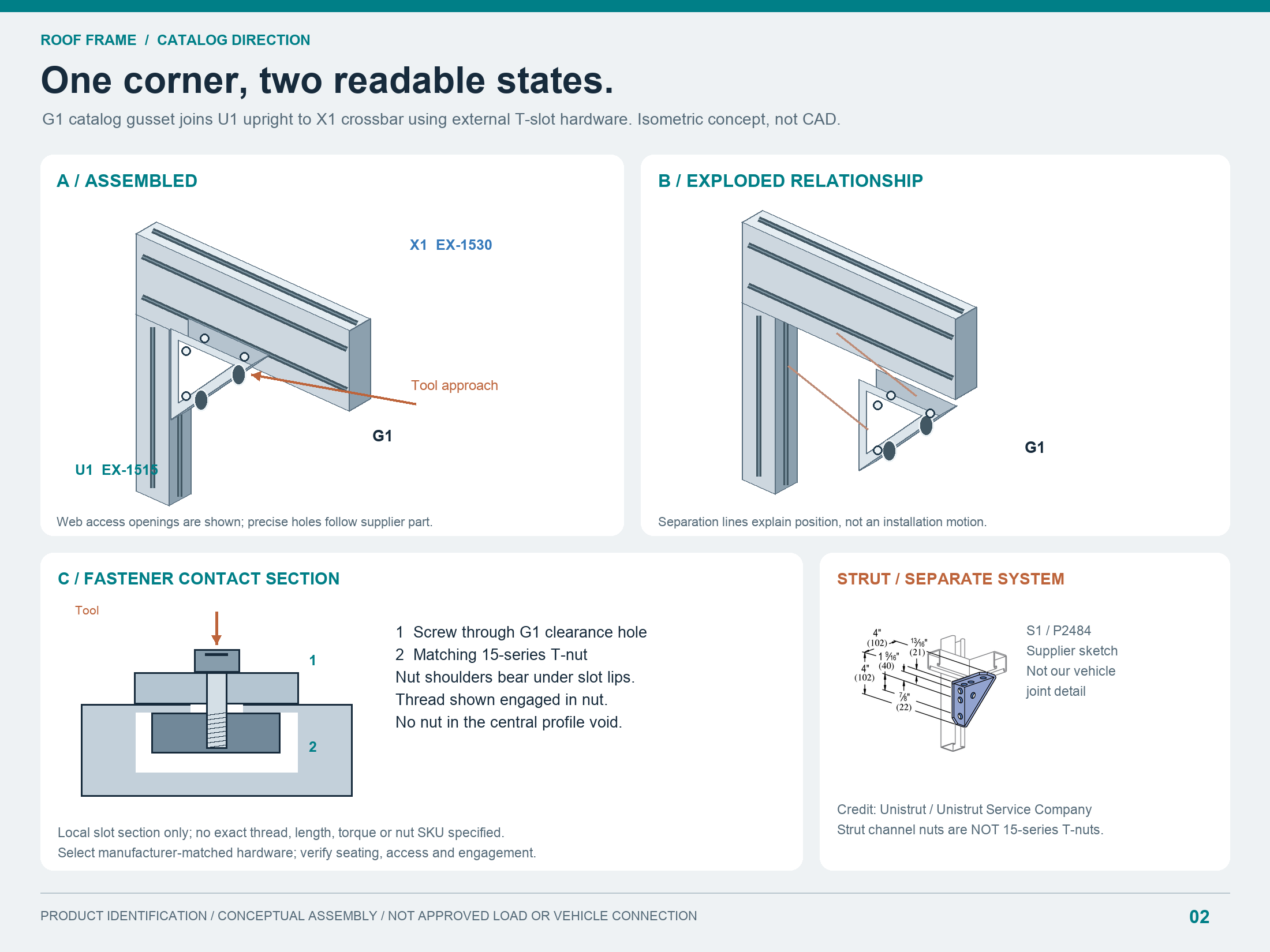
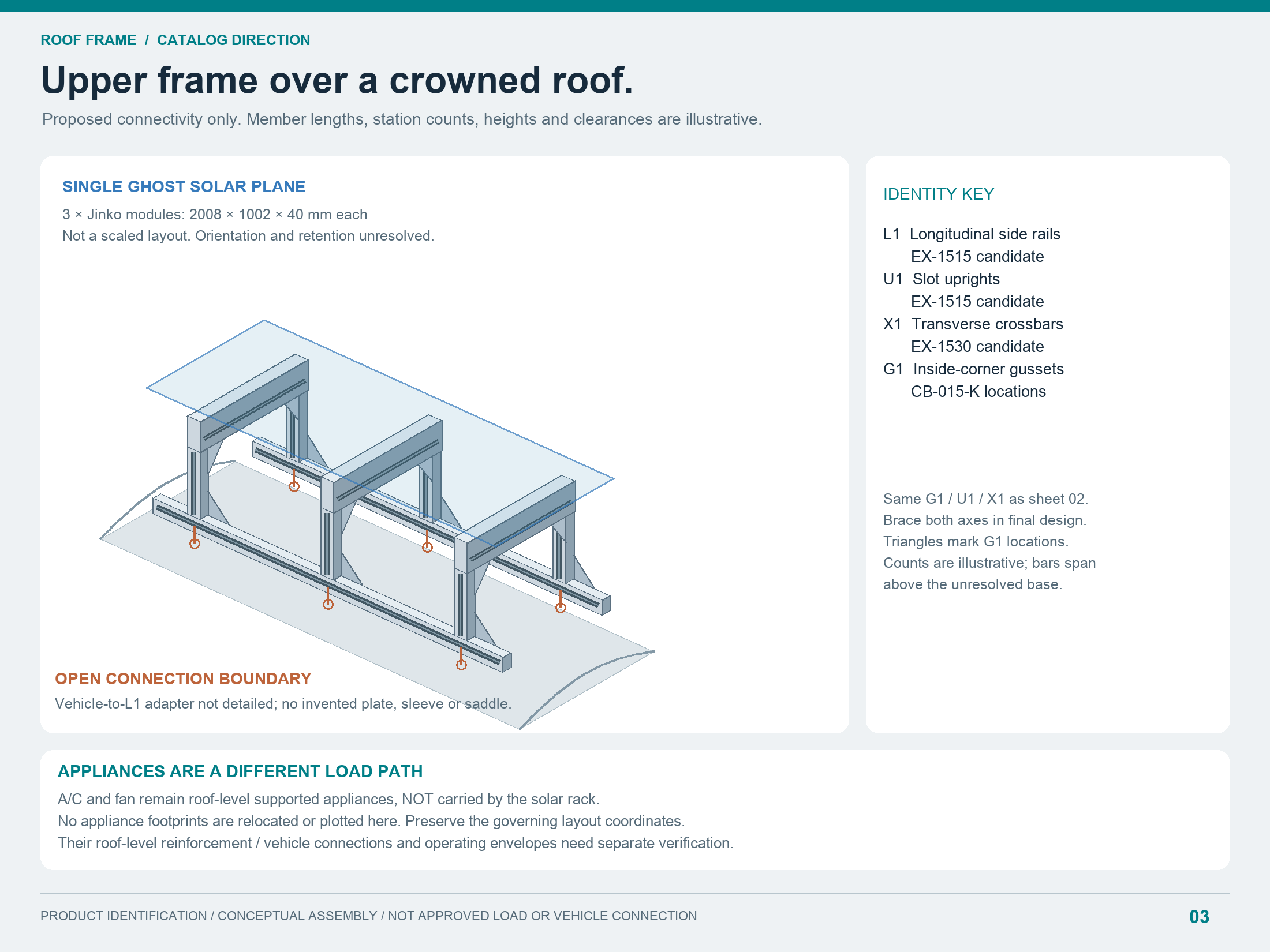
All three sheets as one download: the catalog parts packet (PDF, 3 pages) →. Drawn by Mickey; supplier photographs credited on the sheets.
The shortlist
prices as displayed on the supplier page at the 2026-09-16 check · not quotes, not shipped cost
| Part | Where it goes | Price | What it mates with |
|---|---|---|---|
| Unistrut P2484 7-hole 90° gusseted fitting main candidate |
The braced corners — upright to side rail at the bottom, upright to crossbar at the top. This is the part that does the job of a baseplate plus a separate gusset, in one piece. | $14.30 ea electrogalvanized box of 20 $279.40 |
1⅝″ strut channel, through channel nuts. Holes are for ½″ fasteners. Both legs 4″ (102 mm), first hole ¹³⁄₁₆″ (21 mm) from the end, 1 ⁹⁄₁₆″ (40 mm) and ⁷⁄₈″ (22 mm) pattern offsets, 1.34 lb per piece in EG. Steel ASTM A1011 SS GR 33 as stocked — also listed in aluminium (ASTM B209 1100F / 5052-H32) as a special metal. |
| Unistrut P1026 2-hole 90° fitting secondary |
Light joining and alignment where a corner does not carry the overturning load — squaring the frame, tying a rail end, holding a light bracket square. | $2.20 ea EG $4.40 hot-dip $14.30 304 stainless |
Same 1⅝″ strut channel and channel nuts, same ½″ hole size. An aluminium variant is listed elsewhere but its price and stock were not re-checked. |
| Unistrut P1000T10EA 1⅝″ × 1⅝″ slotted channel, aluminium, 10 ft stock, cut to length |
The members themselves — side rails, uprights, and crossbars if the frame goes all-strut. Slots run the length, so a fitting can land anywhere along it. | quote required aluminium shows $0.00 — that is a blank, not a price. The $64.90 on that page is 10 ft pregalvanized steel. |
Every fitting above, via channel nuts. Aluminium is ASTM B221 6063-T6. Distributor sells a cut-to-length service on the same page. |
| Channel nuts + bolts and washers P1006–P1010 family required |
Every strut-fitting joint. The nut turns under the channel lips and the bolt comes through the fitting into it. | per family page | The channel series and the thread, chosen together. No SKU or pitch is selected here — that gets confirmed against the actual channel and fitting hole size before ordering. |
What P2484 actually buys us. The old design needed a cut baseplate, two cut angles and a pair of triangular gusset cheeks to make one braced corner, all drilled to a hole pattern nobody had worked out. P2484 is that corner as a single stocked part with the gusset already in it. Supplier application photo → (Unistrut Service Company; despite the filename it is an application picture, not a dimensioned drawing).
The T-slot alternative — upper frame only
a different fastener family, not a drop-in swap
If the upper frame ends up as 15-series aluminium extrusion rather than strut channel, the equivalent corner is a bolt-on gusset that lands in the profile's slots:
| Part | Where it goes | Price | Notes |
|---|---|---|---|
| TNUTZ CB-015-K 4-hole 3×3″ inside gusset alternative |
The braced corner, same role as P2484 but in the T-slot world. | $5.25 ea | 6105-T5 aluminium, 0.250″ walls, Ø0.328″ holes on 1.5″ centres. Vendor identifies it with 80/20 4336. |
| TNUTZ CB-015-D 4-hole 3×3″ plain angle alternative |
Where a plain corner is enough and the gusset is not needed. | $3.55 ea | Same material and hole pattern, no gusset. 80/20 4301 equivalent. |
| TNUTZ EX-1530 / EX-1515 1.5×3″ and 1.5×1.5″ profile stock, cut to length |
Crossbars (EX-1530, deep dimension vertical) and uprights (EX-1515). | by length configurator, 1–96″ |
15-series, slot ≈5/16″. 80/20 1530-S / 1515-S equivalents. Use external slot-bolted fittings so no end tapping or access holes are needed. |
What this changes about the crossbar stock
This is the one real design consequence, and it is worth getting straight before anything is ordered.
Catalog fittings bolt into slots. They do not bolt to a plain closed tube. The old design had the crossbar as a plain rectangular aluminium tube, which has no slot for a channel nut to turn in and no holes for a fitting to bolt through. A bare square or rectangular tube does not accept channel nuts. So there are two honest ways forward:
- Switch the crossbar to a slotted member — P1000T aluminium channel, or a 15-series profile like EX-1530. Then every joint on the rack is a catalog fitting into a slot, and the only cutting left is cutting members to measured length. This is the direction that actually removes fabrication.
- Keep the plain rectangular tube — in which case the crossbar-to-upright joint needs a size-matched catalog clamp or saddle, which is not selected. Without one, that joint goes back to drilling the tube and making a retainer, which is the thing we are trying to stop doing.
How it stacks up
conceptual topology — what connects to what, not a load-approved assembly
- 1 · existing gutter attachmentThe factory roof interface and whatever lands on it. Still unverified — capacity, and what sits behind each point. That is a measurement and documentation job, and it does not block choosing the fittings above.
- 2 · fore-aft side railSlotted channel along each gutter line, cut to measured length. Spreads load into several attachment points and gives the supports somewhere to land anywhere along it.
- 3 · catalog gusseted fittingP2484, bolted to the rail through channel nuts. The braced base of each support.
- 4 · uprightChannel or extrusion, cut to the rise the roof crown actually needs.
- 5 · catalog upper fittingP2484 again at the top corner, or a lighter fitting where the load case allows it.
- 6 · matched crossbarSame family as the fittings — slotted, so the fittings and the module hardware both have something to grip.
- 7 · module hardwareWhatever the Jinko JKM405M-72HL-V manual approves, in the size it specifies. Three modules already owned, 148.8 lb of glass.
Not on the shortlist
- P1028 five-hole flat plate — it is a flat plate, a joining piece. Not a 90° bracket, not a saddle, not a riser. It is easy to mistake for one in a catalog listing.
- P2750 four-wheel trolley — a rolling part. A trolley is not an anchor, and nothing on a vehicle roof should be able to move.
- Complete branded rack kits. Not the direction. Earlier text on §02 claimed a Torklift no-drill rack fitting the 2022–25 BrightDrop with 500 lb capacity and Weather Guard EZ-Glide compatibility — none of that was supported by a primary source and all of it stays withdrawn. We are building the rack, not buying one.
Superseded — the fabricated supports
The earlier version of this page specified each support as a bolted assembly of cut parts: a base plate, a short square-tube post, L-angles, triangular gusset cheeks and a fabricated top saddle, all drilled to a hole pattern that was never worked out. P2484 and the T-slot gussets exist precisely so that corner does not have to be made.
Those drawings, and the old illustrated hardware guide that documented them, are off this page and archived: the retired fabrication drawings →. Nothing in that archive is a product or a current instruction.